
Program has operated for eight years, supporting a range of environmental projects in the state
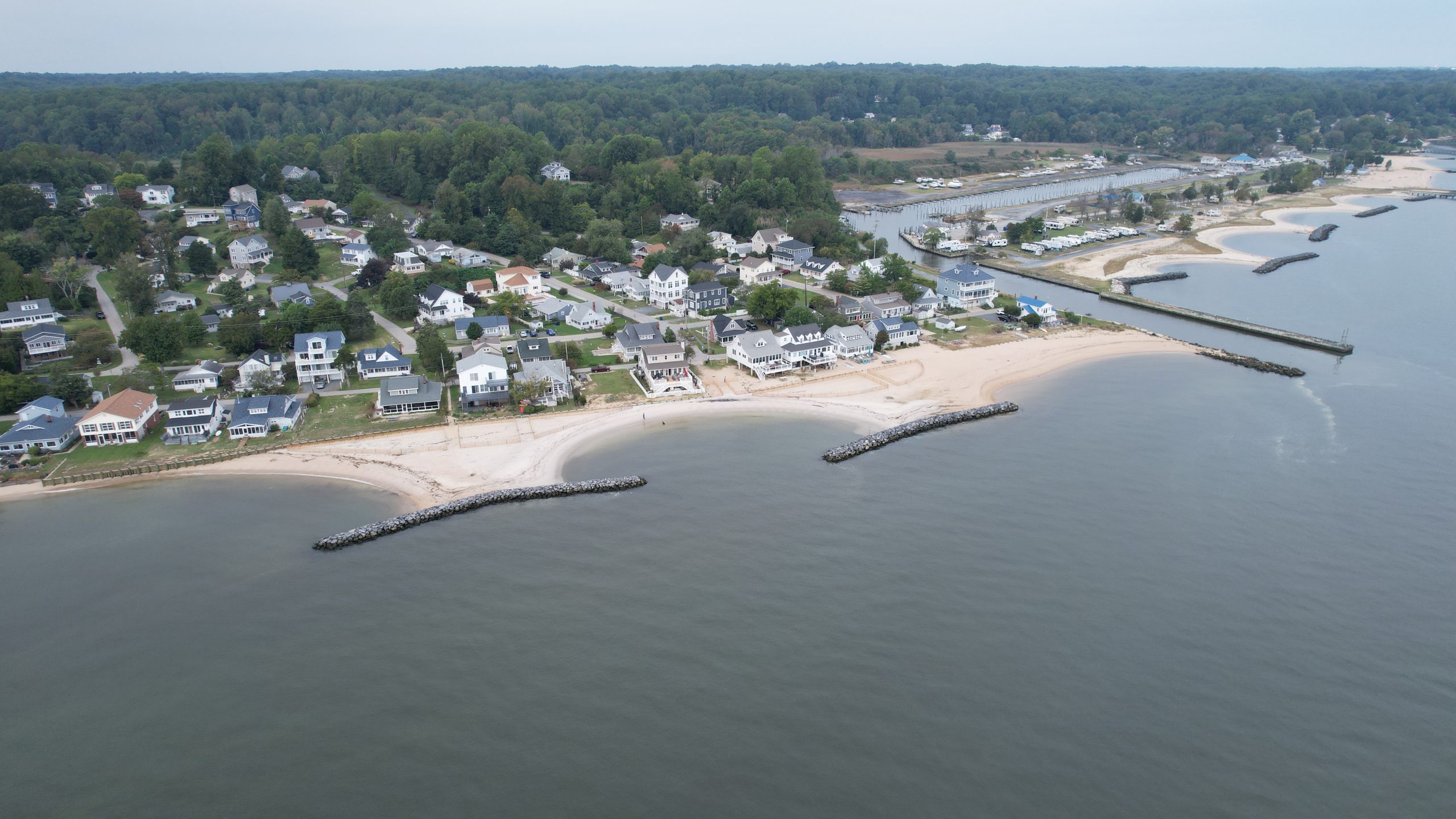
A living shoreline project in Calvert County protecting a neighborhood and surrounding infrastructure, supported by the Resilience through Restoration initiative. DNR photo
In its eight years of operation, Maryland’s Resilience through Restoration Initiative has supported more than three dozen projects in the state and transferred millions of dollars into critical environmental efforts that protect communities, shore up habitat, and provide lasting economic benefits for long-term resilience in coastal areas.
The program prioritizes nature-based solutions to harness the power of living shorelines, wetlands, and natural stormwater practices to help protect communities from flooding hazards rather than relying solely on gray infrastructure like bulkheads and revetments. The projects are supported by strategic state investment, which helps to bring additional support from federal and local funding.
“With 70% of Maryland’s residents living in the coastal zone, communities face increasing threats from coastal erosion, flooding, and sea level rise,” DNR’s Watershed and Climate Services Director Dr. Natalie Snider said. “The state’s Resilience through Restoration Initiative has proven itself a critical program for protecting these vulnerable communities and ecosystems.”
Launched in 2017, the pilot program set out with an ambitious goal: implement at least 15 nature-based demonstration projects that would address escalating risks from extreme weather and climate-related events. The program has overachieved in its initial project goal, rather than implementing 15 projects, it has supported the design and construction of 41 projects across Maryland.
Of these projects, 16 have been constructed, with three currently under evaluation for adaptive management. Construction is currently underway for five additional projects, expected to be complete by the end of 2026.
Annual funding requests for nature-based solutions surged from approximately $1.2 million in fiscal year 2018 to more than $31.5 million in fiscal year 2025. The program has successfully leveraged the initial state investment of $17.25 million over its first seven years, with over $13.7 million in federal, state, and local funding.
“The numbers don’t lie–the program has achieved a remarkable multiplier effect,” said Nicole Carlozo, director of DNR’s Center for Resilient Communities and Landscapes. “This leveraging of funds is one of the program’s greatest strengths. The Resilience through Restoration program is essential in helping Maryland communities compete successfully for these federal dollars which are highly competitive at the national level.”
The initiative’s ability to leverage funding has allowed Maryland communities to capitalize on federal funding opportunities offered by agencies like National Oceanic and Atmospheric Administration, Federal Emergency Management Agency, National Fish and Wildlife Foundation, and U.S. Fish and Wildlife Service.
This strategic approach creates a unique opportunity to significantly bolster state investments and accelerate progress toward climate adaptation goals.
Beyond flood protection and ecosystem enhancement, these restoration projects deliver significant economic benefits. Research indicates that environmental restoration projects can support up to 33 jobs per $1 million of investment, stimulating economic growth, employment, and skills development across multiple industries. A 2018 study by the National Institute of Building Sciences found that every $1 invested in disaster resilience saves $6 in future costs.
Resilience through Restoration projects include:
Chesapeake Bay Environmental Center Thin Layer Sediment Placement, Queen Anne’s County
- This innovative $481,500 project showcases an emerging strategy to protect tidal marshes by utilizing dredged material from Price Creek.
- Grantees and partners: Chesapeake Bay Environmental Center (design) and Queen Anne’s County (construction).
- Status: Construction completed in winter 2025, additional planting planned for spring 2026.
- $1,035,604.00 tax district loan through the Waterway Infrastructure Fund (dredged 8,494 cubic yards of material from Price Creek).
- $500,000 U.S. Fish and Wildlife Service National Coastal Wetlands Conservation Grant for shoreline.
- $500,000 Trust Fund grant for shoreline.
- Pre-construction monitoring funded through NOAA Coastal Zone Management.
Church of the Guardian Angel Green Infrastructure, Baltimore City
- A project that involved constructing green infrastructure practices, such as permeable pavers, to create a green alley and complement Baltimore City stormwater infrastructure improvements. The work improves water quality and helps reduce stormwater flooding in the neighborhood of Remington.
- Grantee and partner: Church of the Guardian Angel.
- Status: Construction completed winter 2025.
- $1,500 Church of the Guardian Angel.
- $126,513 in capital funds.
Neeld Estate Living Shoreline, Calvert County
- This project involved constructing a 850-linear-foot living shoreline along the Neeld Estate community that reduces erosion and increases community resilience.
- Grantees: Neeld Estate Citizens Association (design), Arundel Rivers Federation (construction).
- Status: Construction completed fall 2025, with additional planting planned for spring 2026.
- $35,000 Chesapeake Bay Trust.
- $153,474 Chesapeake & Atlantic Coastal Bays Trust Fund.
- $1,400,000 in capital funds.
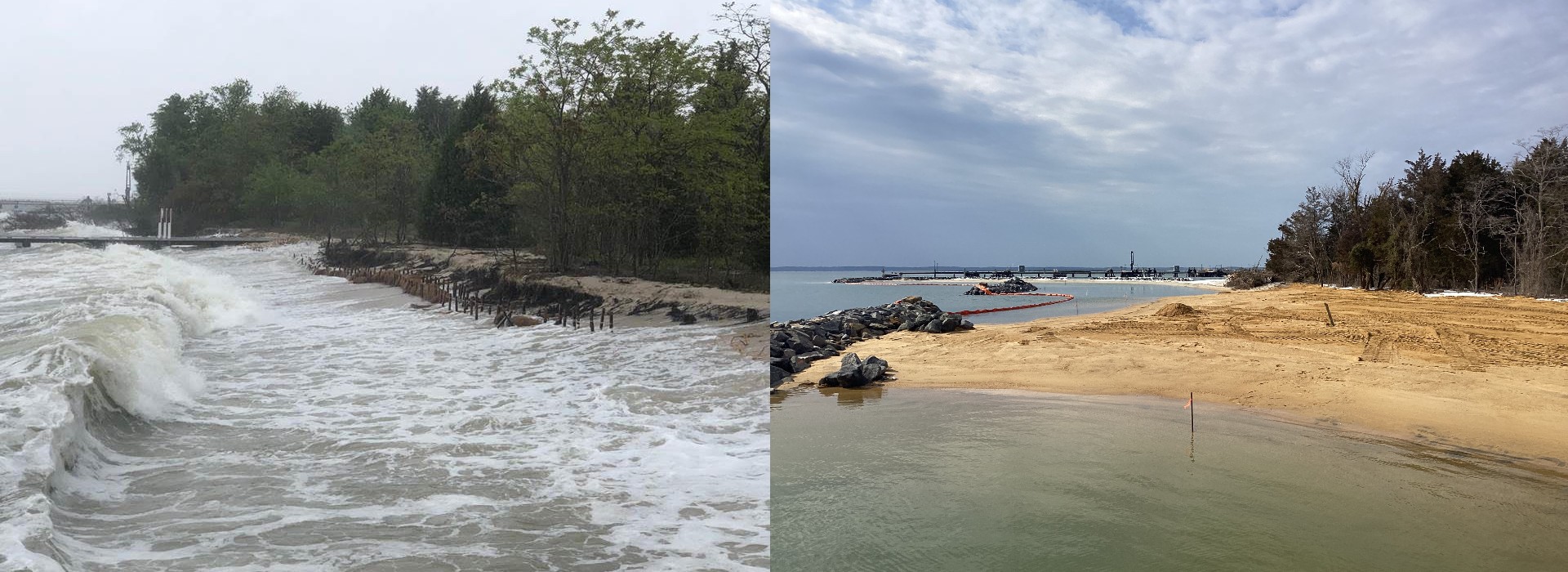
Left: Waves batter the coastline of Piney Point in May 2020. Right: The ongoing living shoreline project provides a buffer that protects the shore.
Piney Point Lighthouse and Museum Shoreline Resiliency Project, St. Mary’s County
- This ongoing project will construct a 1,100-linear-foot living shoreline with climate resilient features to protect infrastructure at Piney Point Lighthouse Museum and Historic Park.
- Grantees and partners: St. Mary’s County, Southern Maryland Resource Conservation and Development.
- Status: Under construction.
- $1,938,000 National Fish and Wildlife Foundation Emergency Coastal Resilience Fund.
- Pre-construction monitoring in-kind from St. Mary’s College of Maryland students.
- $60,000 in capital funds.
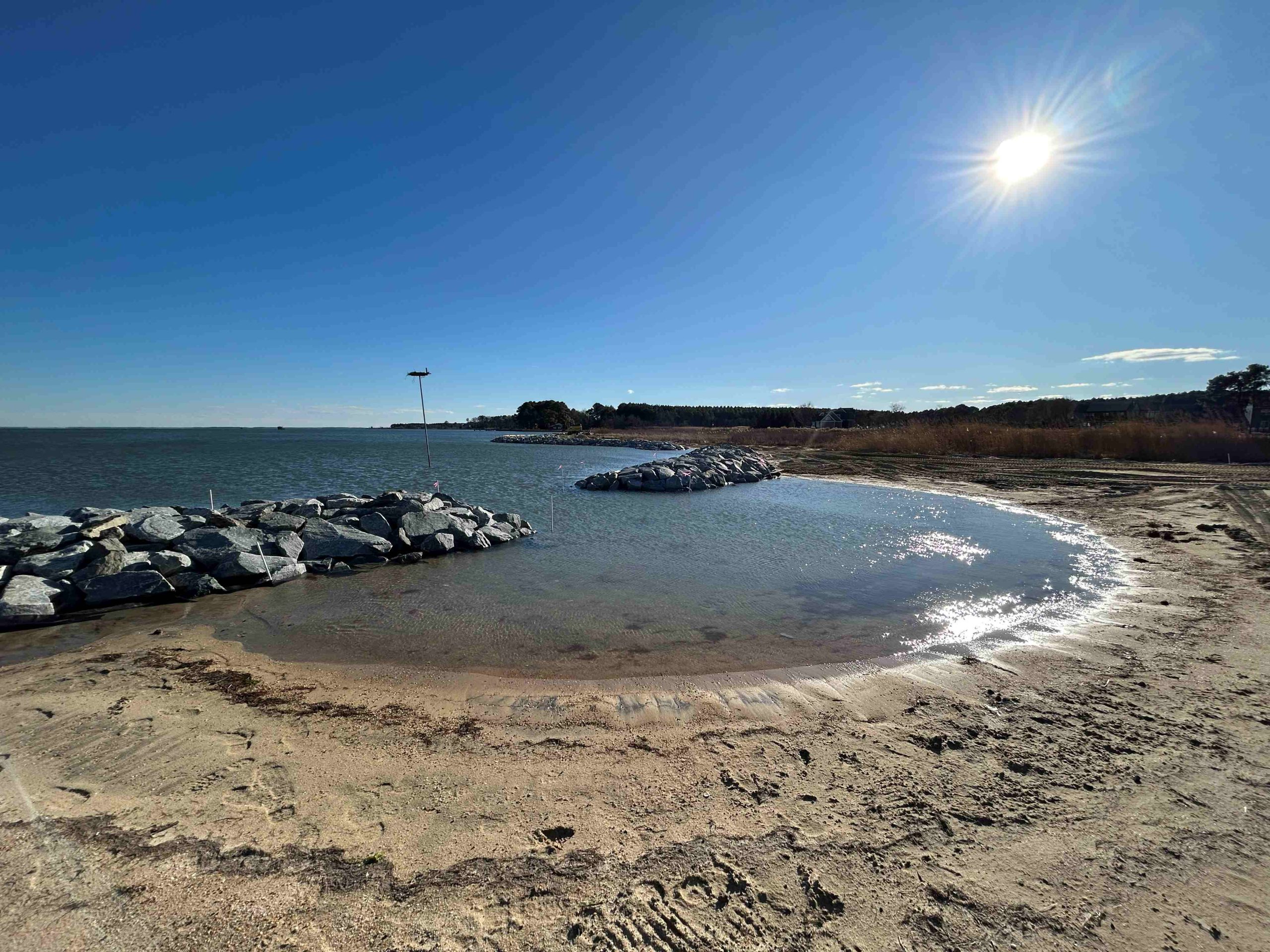
A living shoreline on Tilghman Island. DNR photo
Tilghman Island, Talbot County
- This project includes a 975-linear-foot living shoreline as well as upland stormwater practices with oyster, marsh migration, dune, wetland, and meadow components to enhance resilience and serve as a demonstration site for Talbot County’s Green Infrastructure Plan.
- Grantees and partners: Talbot County, Tilghman on the Chesapeake Community Association, Maryland SeaGrant Extension.
- Status: Under construction, planting planned for spring 2026.
- $33,980 NOAA Coastal Zone Management.
- $979,267 NFWF Innovative Nutrient and Sediment Reduction.
- $433,363 in capital funds.
Legislation is proposed in this 2026 session to codify and expand this successful program, transforming it from a pilot program into a permanent fixture of Maryland’s climate adaptation solutions. If approved, the program would be expanded state-wide to address a wide range of climate threats and will help to continue to secure new federal investments.
“Codifying the Resilience through Restoration program would reflect the growing recognition that nature-based solutions must be central to our climate adaptation strategy. The proposed legislation positions Maryland as a leader in climate resilience and affirms our commitment to protect communities against intensifying storms and rising waters.” said Lydia McPherson, DNR’s Director of Legislative and Constituent Services.
